

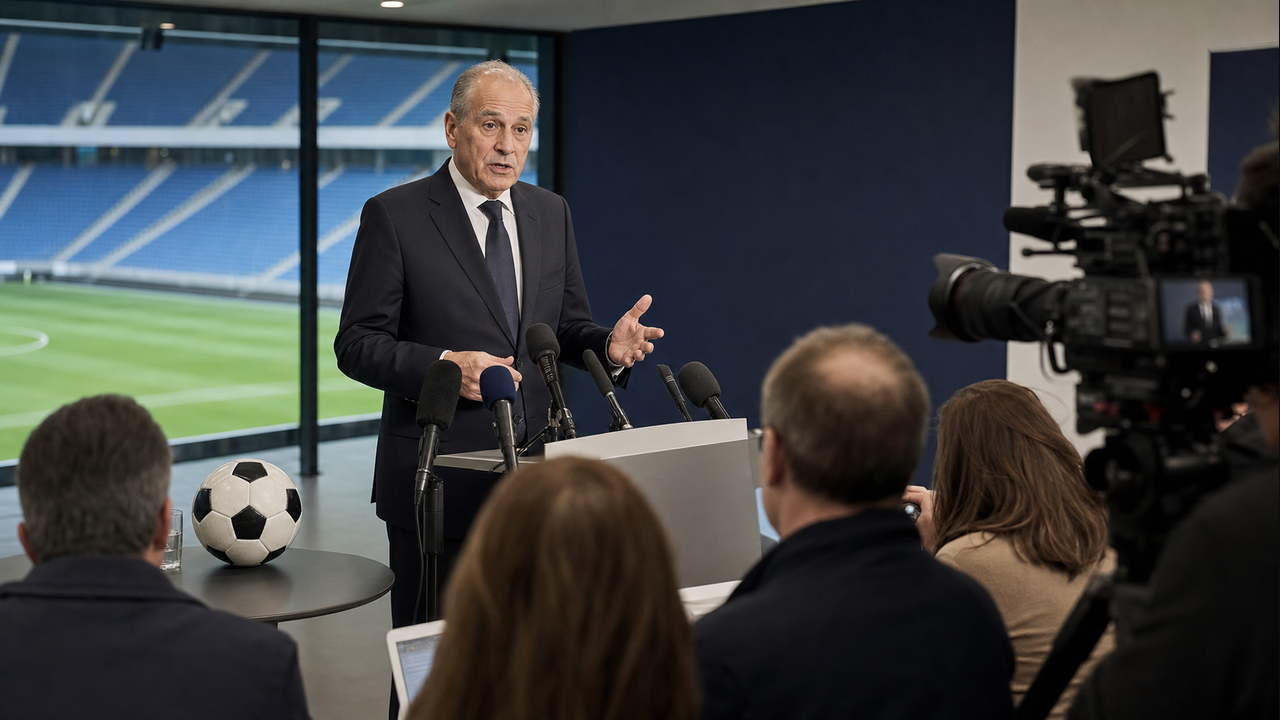
GENEVA — Europe’s leading human rights body has questioned the integrity of the World Cup and urged FIFA to begin building stronger safeguards for the 2030 tournament, which will be played mainly in Spain and Portugal.
Alain Berset, head of the 46-nation Council of Europe, made the appeal in an open letter to FIFA before the World Cup final between Spain and Argentina in East Rutherford, New Jersey. The Swiss politician warned that soccer’s next crisis involved “money and power.”
Berset cites Balogun disciplinary ruling
Berset pointed to FIFA’s decision to suspend a mandatory one-game ban for United States forward Folarin Balugun. The change allowed Balogun to face Belgium with a quarterfinal place at stake after President Donald Trump contacted FIFA president Gianni Infantino.
Belgium won 4-1, but Berset argued that altering a sanction under political pressure left the competition’s rules open to doubt. He also noted that FIFA had not published documents explaining the reasoning of the disciplinary judge from the United Arab Emirates.
UEFA fiercely criticized the ruling, saying FIFA had crossed a red line involving the rule of law and transparency in soccer.
Prediction market deal raises fraud concerns
The letter also challenged FIFA’s reported $150 million sponsorship agreement with ADI Predictstreet, an Abu Dhabi-backed prediction market signed one week after the company was formally created. FIFA has additional World Cup commercial agreements involving the gambling industry.
Prediction betting has faced criticism over the potential to reward insider trading. Berset highlighted markets tied to moments a single player can produce without changing the score, describing that structure as an open door to fraud.
His wider list of concerns from the first 48-team, 104-game World Cup included challenges to referee authority, racist abuse directed at players — some from elected officials — and betting markets covering passes, cards and corners.
Council of Europe proposes 2030 integrity framework
The Council of Europe made its criticism public despite a formal working agreement with FIFA signed by Infantino in 2018. The organization created the European Convention on Human Rights and promotes democracy, human rights and the rule of law across Europe and beyond.
When the FIFA-CoE agreement was completed, Infantino described the organizations as sharing goals involving transparency, accountability, integrity, safety in sport and respect for human rights and children’s rights. He later met Berset during a United Nations gathering in New York in 2024.
The 2030 World Cup will be staged mostly in Europe, with Morocco joining Spain and Portugal as a co-host. Argentina, Paraguay and Uruguay are scheduled to stage one game each at the beginning of the tournament in June 2030, marking the centenary of the original World Cup hosted by Uruguay in 1930.
Berset proposed that the Council of Europe and FIFA open a working dialogue immediately so an integrity framework can be established before the 2030 tournament is played.