


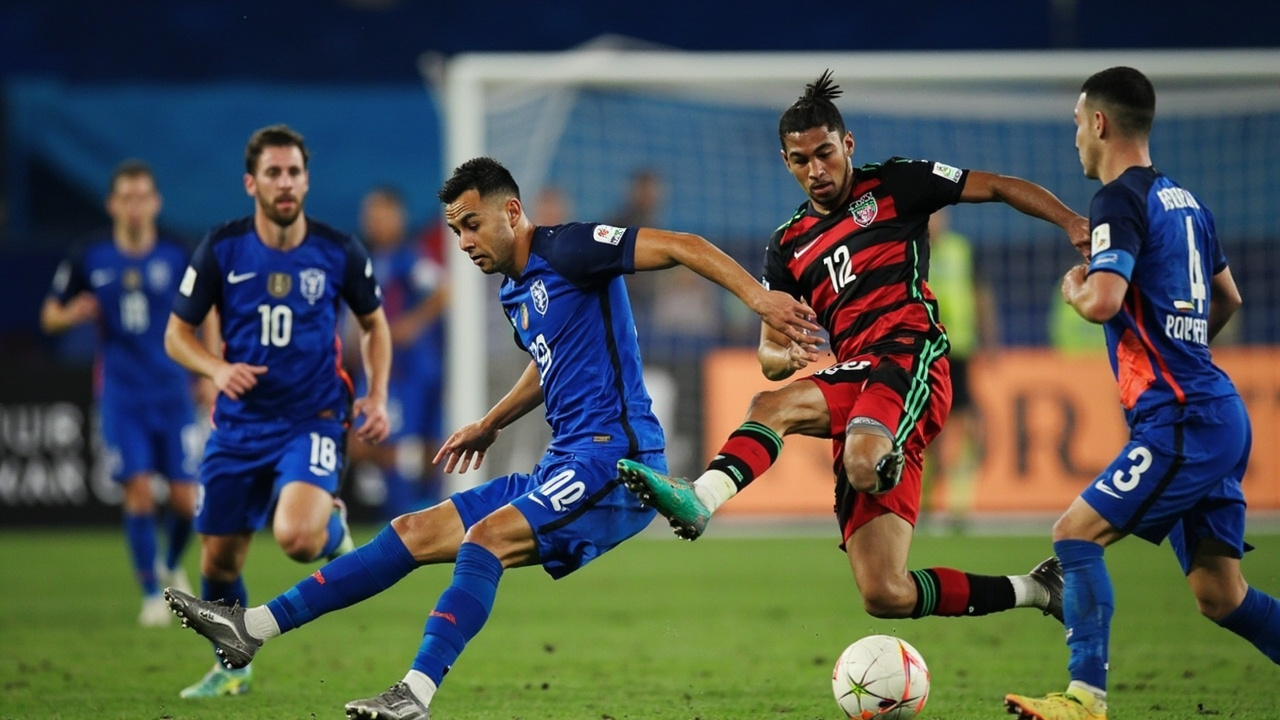
The 2026 World Cup will be the largest ever staged, with 48 teams competing across three host countries and 16 stadiums over 39 days. The tournament in the United States, Canada and Mexico will feature a record 104 matches, the first since FIFA expanded the field from 32 to 48 teams.
Eleven venues will be in the United States, three in Mexico and two in Canada. Mexico will host 13 matches, including the opener on June 11 in Mexico City between the host team and South Africa, plus three knockout-round games. Canada gets 13 matches as well, starting June 12 in Toronto against Bosnia-Herzegovina. The remaining 78 matches shift to the U.S., where the Americans open against Paraguay on June 12 in the Los Angeles area.
The matchup already has enough history; the job is to keep the reading list shorter than the tension.
All quarterfinals, semifinals and the final will be at MetLife Stadium in New Jersey.
The rosters feature 1,248 players from 449 domestic clubs across 71 countries, with 891 first-timers and 357 veterans. England leads with 200 players based at home clubs, followed by Germany (109), France (86), Spain (86), Italy (71) and Saudi Arabia (49). Major League Soccer contributes 44 active players, with 103 having some MLS experience.
Manchester City contributes the most players from any club with 19, ahead of Bayern Munich (18), Paris Saint-Germain and Arsenal (16 each) and Barcelona (15).
Portugal's Cristiano Ronaldo enters with 226 caps, the most ever for a men's player, and will become just the second player to appear in six World Cups. He's the only player to score in five different tournaments. Argentina's Lionel Messi holds the record with 26 World Cup matches and needs two more appearances to reach 200 caps, joining Kuwait's Bader Al-Mutawa in that club. Croatia's Luka Modric is three short.
Mexico's Guillermo Ochoa makes his sixth World Cup roster, though he didn't play in 2006 or 2010. Germany's Miroslav Klose's record of 16 career goals could be challenged—Messi has 13, Brazilian Ronaldo has 15 and Gerd Muller 14. France's Kylian Mbappe has 12 goals from the past two tournaments.
Eight countries have won the World Cup, with Brazil leading with five titles. France won its first in 1998 and Spain in 2010—the only first-time winners in the last 11 editions. Only Brazil and Italy have repeated as champions, in 1958-62 and 1934-38 respectively.
Brazil remains the only nation to appear in all 23 editions, with 76 wins, 237 goals and a plus-129 goal differential. Germany has 21 appearances, 232 goals and plus-102.
Four nations make their World Cup debut: Cape Verde, Curaçao, Jordan and Uzbekistan, pushing the total to 84 countries that have competed in the tournament.
Egypt has played seven World Cup matches without a win (0-5-2) and faces Belgium on June 15. Honduras holds the record with nine winless matches but did not qualify this time.
With 40 additional games from the expansion, the 2022 record of 172 goals should fall. The oldest player, Scotland goalkeeper Craig Gordon, will be 43 years and 162 days old when the tournament starts. Mexico's Gilbert Mora will be 17 years and 240 days old—the youngest by more than 25 years.
What the expansion actually means
The jump from 64 to 104 matches is not simply arithmetic—it adds a full round of 32 teams in the group stage and a new knockout round before the round of 16. That means more games for fringe nations but also more fatigue for the teams that advance deep. The record 172 goals scored in Qatar will almost certainly fall, but the average goal-per-game mark set in 1954 at 5.38 is safe—pace has slowed, not sped up.