


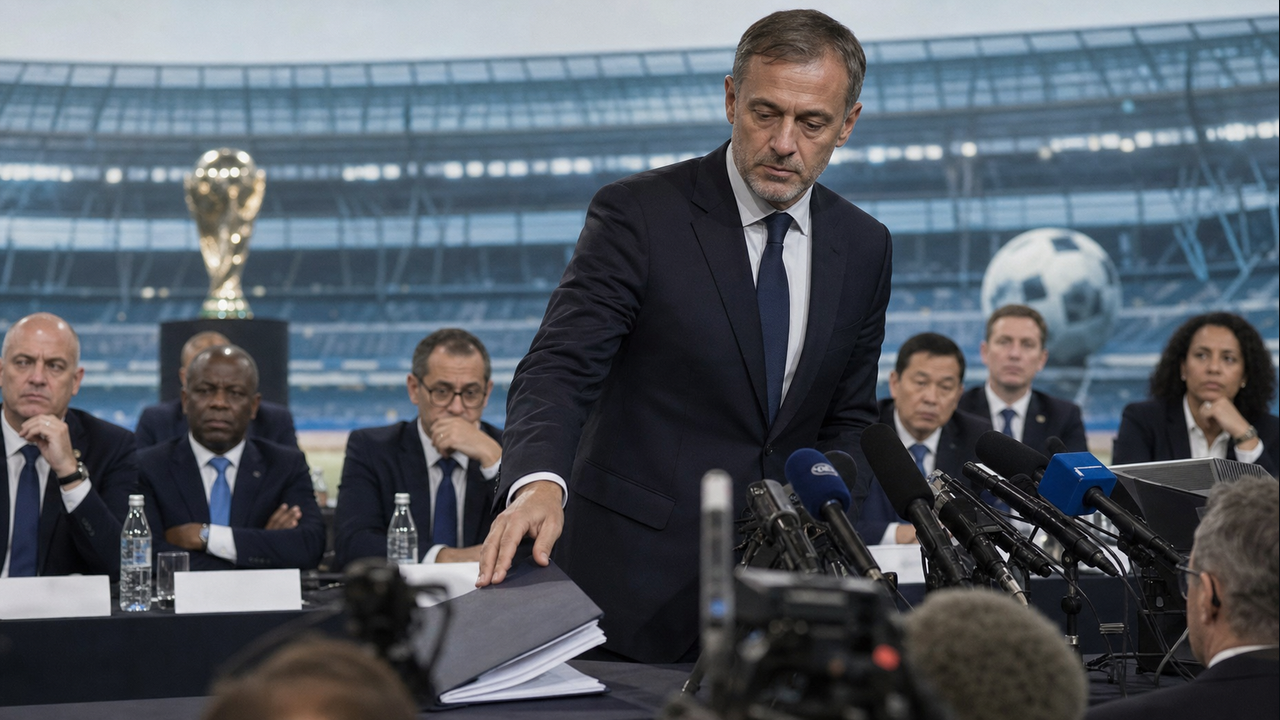
Less than two weeks after sitting alongside U.S. President Donald Trump at the World Cup final, Gianni Infantino has been forced to abandon a private investment proposal that caused a major split inside FIFA and put his leadership under pressure.
Trump has called Infantino the “King of Soccer,” and the allies watched the July 19 final together at MetLife Stadium near New York. Some spectators booed as they crossed the field to present the trophy and medals to players from Spain and Argentina.
The final was the 104th match of FIFA’s biggest tournament. Its success on the field and record financial returns appeared to strengthen Infantino’s position before the next presidential election. That outlook changed sharply when details of his investment project emerged.
FIFA Forward Enterprise Would Have Sold A 20% Stake
Infantino, 56, proposed moving FIFA’s revenue-generating operations into a subsidiary called FIFA Forward Enterprise, or FFE. It would have controlled tournaments including the World Cup, along with broadcasting, sponsorship, ticketing and hospitality sales.
Investors would have provided $4.2 billion for stakes totaling about 20%, based on an equity valuation of $20 billion. The proposed anchor investor was Thrive Eternal, launched by Joshua Kushner. His brother, Jared Kushner, is Trump’s son-in-law.
The plan would have given private investors access to future profits from World Cups and other FIFA events. Private equity and sovereign wealth investment have become common in European club soccer, but many within the game opposed applying that model to the World Cup, which supporters have long regarded as a competition belonging to the wider soccer community.
FIFA’s 211 national associations, which already effectively own the governing body through its status as a nonprofit association under Swiss law, were each offered $20 million. They had until Sept. 19 to accept.
Each association is already due $10 million during the coming FIFA cycle, financed largely by the record $15 billion in revenue generated during 2023-26 and tied to the World Cup that had just ended. FIFA projected that FFE would double that distribution to $20 million, followed by $22 million through 2034 and $24 million through 2038.
Those amounts could transform the finances of smaller federations such as Andorra, Montserrat and Papua New Guinea. Wealthier soccer nations including England, Spain and France approached the proposal with different priorities.
UEFA Threatened To Boycott FIFA Competitions
Opposition spread across FIFA’s leadership, its senior staff and much of international soccer. FIFA vice presidents, European federations, the governing bodies for Asia and North America, Britain’s Prime Minister, the global organization representing national leagues and supporters around the world all challenged the project.
Former Goldman Sachs banker Carlos Cordeiro resigned as Infantino’s senior adviser and described the proposal as a bad deal. FIFA chief operating officer Kevin Lamour issued a forceful defense of colleagues who believed they had been deceived, in a statement that effectively invited Infantino to dismiss him.
UEFA then threatened to withdraw European teams from every FIFA competition unless the proposal was dropped. The threat carried significant financial weight because European teams regularly dominate the men’s World Cup and Club World Cup, FIFA’s leading revenue-producing competitions.
European officials feared investors would demand more matches and expanded tournaments to improve returns. That could reduce attention and revenue for club competitions including the Champions League at a time when fixture calendars are already congested, leading players are operating near their limits and broadcasting and sponsorship money is finite.
There was also widespread anger over the lack of consultation while the project was developed during the previous year, when Infantino had spent substantial time around Trump. Even Trump said Friday that he had not discussed the plan to sell tournament stakes with the FIFA president.
Infantino announced Friday that the project had been abandoned. “Having listened carefully to all the views, it has become clear that the project has created divisions of a nature that, regardless of the level of support, are no longer in the interest of the objective set out in the first place,” he said.
Infantino Faces Questions Before FIFA Election
Africa, traditionally a major part of Infantino’s support base with 54 of FIFA’s 211 voting members, had remained neutral despite the substantial financial offer. South American governing body CONMEBOL said Friday that it had received the proposal and would assess the issue “with the rigor it demands.”
CONMEBOL is led by FIFA vice president Alejandro Dominguez of Paraguay, who is depending on Infantino’s proposal to expand the 2030 World Cup to 64 teams. Expansion would provide additional matches for minority co-hosts Argentina, Paraguay and Uruguay, host of the inaugural 1930 tournament.
Under the existing arrangement, Argentina, Paraguay and Uruguay are each due to stage one of the tournament’s 104 matches. The remaining games are assigned to Spain, Portugal and Morocco.
Infantino had left New York City with letters of election support from about 200 member federations. After the revolt over FFE, it is unclear how many of those commitments remain firm, even though the plan has now been withdrawn.
The UEFA-led resistance succeeded in stopping the proposed sale, but Infantino still faces questions about whether he retains enough credibility to continue. The public interventions by Lamour and Cordeiro intensified doubts about his position after he had previously appeared secure.
Nov. 18 is the deadline for candidates to enter the next FIFA presidential race. The vote will be held in Rabat, Morocco, where FIFA maintains its African headquarters.
Infantino was returned unopposed in Paris in 2019 and again in Kigali, Rwanda, in 2023. FIFA’s statutes permit him to serve one additional term.
The FFE structure also appeared capable of creating a commissioner-style position for Infantino beyond 2031. Such a role likely would have paid more than his current annual salary and bonus package of over $6 million.
A candidate would need 106 votes to guarantee a majority in a contested election. Confederations do not necessarily vote as unified blocs, but Europe’s 55 members, CONCACAF’s 35 and Asia’s 46 would form a substantial electoral base.
Possible challengers discussed within the game include Paris Saint-Germain’s Qatari president Nasser al-Khelaïfi and Canadian FIFA vice president Victor Montagliani. That prospect appeared unlikely until the investment dispute, despite longstanding unease over Infantino’s leadership style and earlier attempts to push through unpopular projects.