

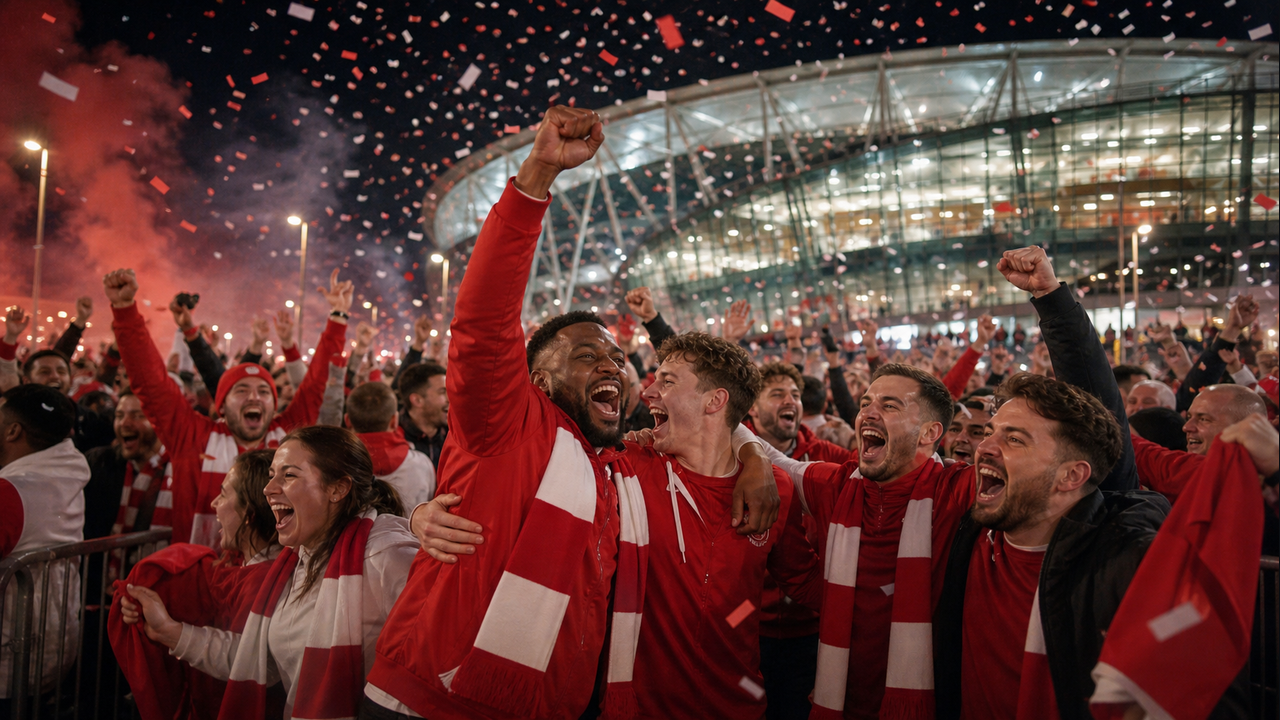
GENEVA — Arsenal’s title celebrations in north London closed a European soccer season defined by long waits ending, first-time champions emerging and established powers losing their grip.
Arsenal’s 22-year wait for another league title ended when Manchester City drew a must-win game at Bournemouth. Elsewhere, AGF of Aarhus ended a 40-year drought in Denmark, while LASK of Linz became champion in Austria for the first time in 61 years.
First-time champions were part of the same pattern. Thun, a 128-year-old club in Switzerland, and Mjällby, an 87-year-old club in Sweden, both won league titles for the first time.
Scandinavia helped set the pattern
Mjällby’s title came first, followed by Viking ending a 34-year wait for the Norwegian title. Viking’s revival also meant overtaking Bodø/Glimt, the Arctic Circle club that had built its own European profile with wins over Manchester City, Atletico Madrid and Inter Milan.
Denmark added another long-awaited champion when AGF won under Jakob Poulsen, a former player at the club. Thun followed a similar route with Mauro Lustrinelli, another former player who returned as coach.
Established champions lose control across Europe
Several dominant clubs were displaced. Ludogorets had won 14 straight titles in Bulgaria before Levski Sofia returned to the top, weeks after the club was bought by former Goldman Sachs investment banker Atanas Bostandjiev.
In Azerbaijan, Sabah won its first title after being created in the modern era. Qarabag, champion in 11 of the previous 12 seasons, finished second after also playing in Europe and beating Benfica, a result that led to Jose Mourinho returning to coach his former club.
Hungary also had a change at the top as ETO edged Ferencvaros, coached by Ireland great Robbie Keane, by one point. In Romania, Universitatea Craiova won its first title since 1991, with Assad Hamlawi, from the Palestinian national team, finishing as its 11-goal top scorer.
Austria’s title went to LASK after Salzburg’s decade of control weakened following the decline of the Red Bull-affiliated club. In France, Lens pushed Qatari-owned Paris Saint-Germain deep into the race while chasing a first title since 1998.
Scotland produced one of the sharpest near-misses. Heart of Midlothian led the Scottish Premiership until the 87th minute of a match at Celtic, extending the low-budget, fan-owned Edinburgh club’s run of last-day heartbreak since its previous title in 1960.
Jarosz points to data, education and new investors
Olivier Jarosz, a director of LTT Sports who advises investors and clubs across Europe, said the trend across the continent’s 54 national leagues reflects better access to club-management knowledge and player data.
Jarosz pointed to the 800-member European Football Clubs group, improved scouting systems and broader education around management structures. “It’s possible to create a good team on a small budget anywhere in the world,” he said.
UEFA’s creation of the Conference League in 2021 has also raised ambition and revenue for some clubs while stretching the squads of others. Jarosz also cited new investors at smaller clubs, including Brighton owner Tony Bloom taking a stake in Hearts, as part of a changing mindset.
Staying on top may be the harder part for the new champions. Jarosz warned that successful smaller clubs can quickly become targets for richer rivals seeking their staff and players.